4-Tage-Woche Arbeitszeit berechnen: So verteilst du deine Wochenstunden richtig

The 4-Tage-Woche trend keeps gaining traction, but figuring out exactly how many hours to work each day takes some careful math. Whether you’re negotiating a new schedule or just curious how the numbers shake out, this guide walks through calculating daily and monthly hours under a Vier-Tage-Woche model, step by step.
Was bedeutet eine 4-Tage-Woche für die tägliche Arbeitszeit?
Switching to four working days usually means compressing the same weekly total into fewer, longer days. Instead of five 8-hour shifts, you might work four 10-hour shifts instead.
This shift changes your daily rhythm significantly. Longer individual days mean tägliche Arbeitszeit planning becomes more important, especially around break timing and energy management throughout each shift.
Wie verteilt man eine 40-Stunden-Woche auf vier Arbeitstage?
The straightforward math: forty hours divided by four days equals exactly ten hours per day. That’s the most common 40 Stunden 4 Tage arrangement companies adopt.
Ten-hour days require careful break planning to stay compliant with rest requirements. Longer shifts generally need more or longer breaks compared to a standard eight-hour day.
Wie berechnet man die Arbeitszeit bei 32 oder 36 Wochenstunden?
Not every 4-Tage-Woche model keeps the full 40-hour week intact. Some companies genuinely reduce total hours as part of the arrangement, changing the daily math considerably.
| Wochenstunden | Stunden pro Tag (4 Tage) |
|---|---|
| 32 Stunden | 8 Stunden |
| 36 Stunden | 9 Stunden |
| 38 Stunden | 9,5 Stunden |
| 40 Stunden | 10 Stunden |
Check your specific contract to know which model applies to you.
Wie werden Pausen bei langen Arbeitstagen berücksichtigt?
Ten-hour shifts typically require longer combined break time than standard eight-hour days under German Arbeitszeitgesetz rules, often pushing past the standard 45-minute minimum.
Planning two shorter breaks instead of one long one sometimes works better for energy levels during extended shifts, though total break minutes matter more than exact placement.
Wie berechnet man Monatsstunden bei einer 4-Tage-Woche?
Multiply your daily net hours by the number of working days that month. With ten-hour days and roughly seventeen working days in a typical month, that’s around 170 Monatsstunden.
This number fluctuates slightly month to month depending on how many of each weekday fall within it, so exact totals require checking a calendar rather than assuming a fixed average.
Wie unterscheiden sich Arbeitszeit und Anwesenheitszeit?
Arbeitszeit means actual working hours, while Anwesenheitszeit includes breaks and any downtime spent physically present but not actively working.
This distinction matters for payroll accuracy. A ten-hour scheduled shift with a 45-minute break results in 9.25 hours of true Arbeitszeit, even though you were present for the full ten.
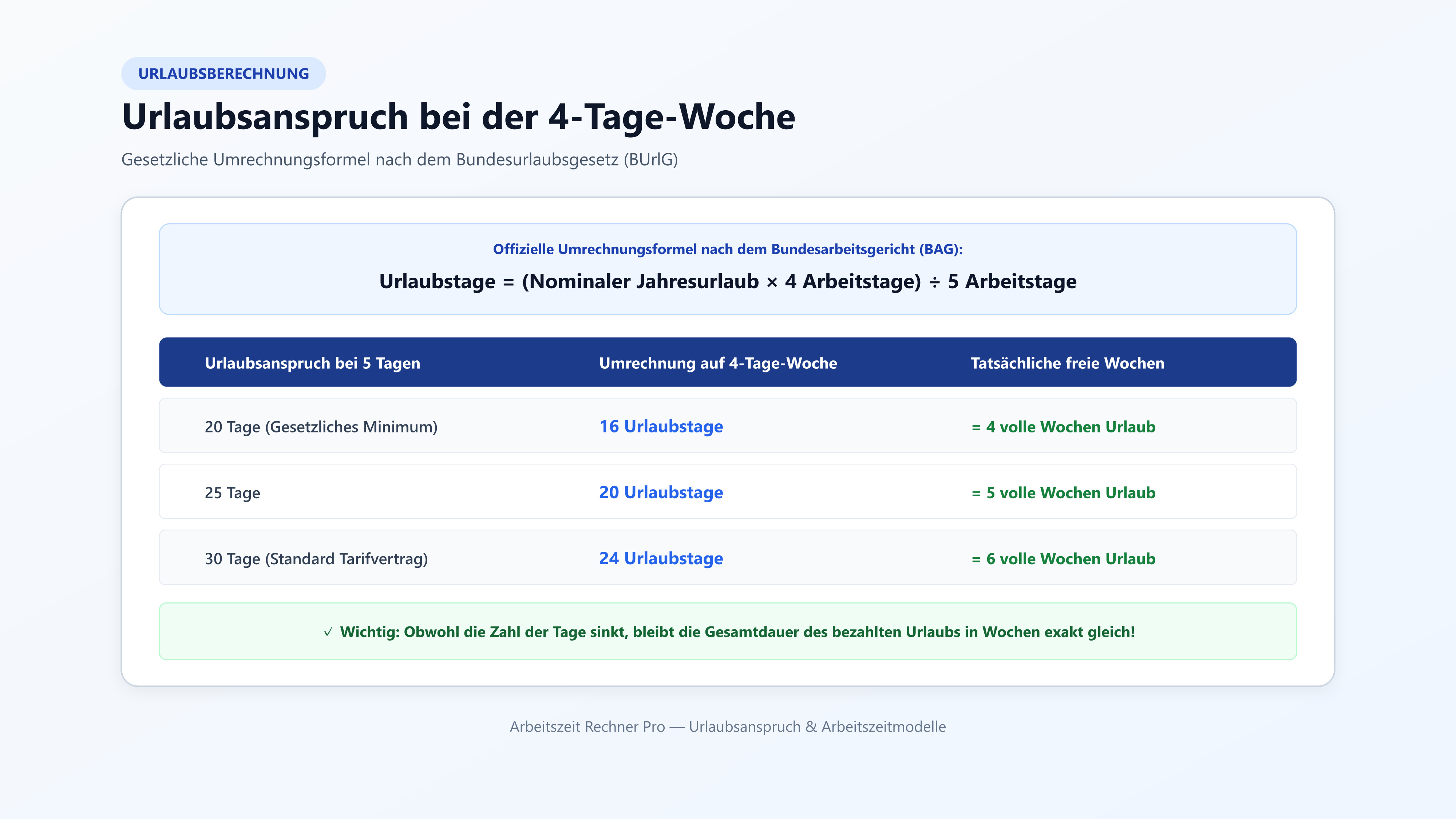
Wie lassen sich Urlaubstage bei einer 4-Tage-Woche berechnen?
Vacation entitlements typically get recalculated when switching schedules. Someone with 20 vacation days under a five-day week generally sees that adjusted proportionally under a 4-Tage-Woche arrangement.
The usual formula multiplies your existing entitlement by four-fifths. Twenty days becomes sixteen, preserving the same total vacation hours despite fewer scheduled working days overall.
Wie funktioniert die Berechnung bei Teilzeit und unterschiedlichen Wochenstunden?
Part-time employees on a 4-Tage-Woche follow the same basic division logic, just starting from a smaller weekly total. Twenty weekly hours across four days equals five hours daily.
Always base calculations on your actual contracted weekly hours, not assumptions about what “normal” full-time looks like, since Teilzeit arrangements vary considerably between individuals.
Wie können Feiertage die Arbeitszeitberechnung beeinflussen?
Public holidays falling on one of your four working days reduce that week’s total scheduled hours. If your four days include a holiday, you’d typically work three days that week instead.
This creates natural monthly variation. Months with multiple Feiertage landing on scheduled workdays will show noticeably lower total hours compared to holiday-free months.
Fazit: Arbeitszeitmodelle für die 4-Tage-Woche richtig berechnen
Calculating hours under a 4-Tage-Woche comes down to dividing your weekly total across four days, then adjusting carefully for breaks, holidays, and vacation entitlements. Whether you’re on a full 40-hour schedule or a reduced-hours model, understanding this math helps you plan your time and your paycheck with confidence.
Quellen und Referenzen
- Bundesurlaubsgesetz (BUrlG) § 3 (Dauer des Urlaubs)
- Arbeitszeitgesetz (ArbZG) § 3 (Arbeitszeit der Arbeitnehmer)
- Teilzeit- und Befristungsgesetz (TzBfG) § 8 (Verringerung der Arbeitszeit)
