Muss dein Arbeitgeber deine Arbeitszeit erfassen? Was das EuGH- und BAG-Urteil für dich als Arbeitnehmer bedeutet
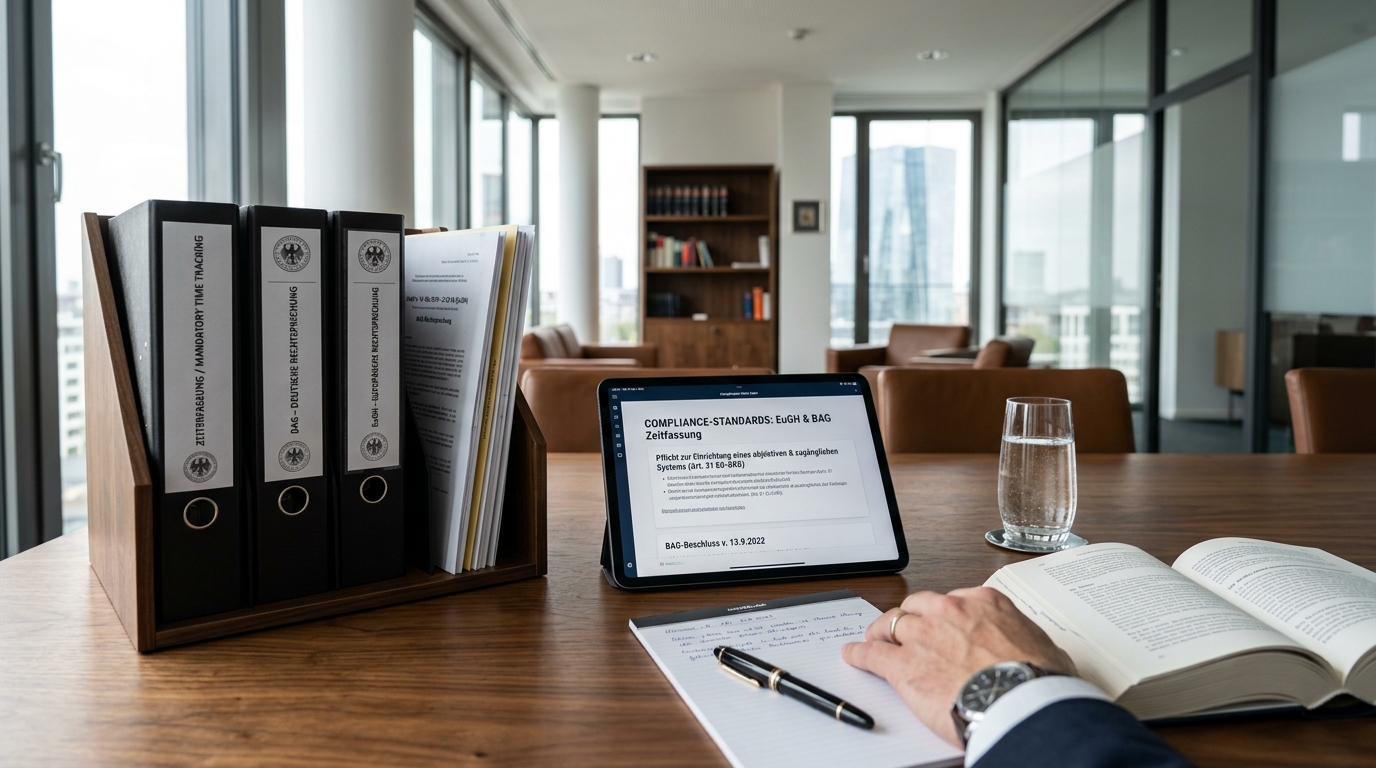
Picture this: you clock out at six, but you know you actually stayed until seven. Nobody wrote it down. For years, workers across Germany faced exactly this problem — no paper trail, no proof, no way to claim what they were owed. That changed after two landmark rulings from the EuGH (Europäischer Gerichtshof) and the BAG (Bundesarbeitsgericht). Together, these decisions answered a question millions of employees had been asking: does your Arbeitgeber really have to track your Arbeitszeit? If you’re unsure how many hours you’ve logged lately, an Arbeitszeit Rechner can help you keep your own running total while company systems catch up. This guide breaks it all down in plain English.
Was haben EuGH und BAG zur Arbeitszeiterfassung entschieden?
In 2019, the EuGH ruled in the case CCOO v. Deutsche Bank that employers across the EU must set up an objective, reliable system to record daily working hours. This wasn’t a suggestion. It was framed as a core worker-protection duty tied to the EU Working Time Directive.
Then in 2022, the BAG went further. Its Beschluss confirmed that German employers are already legally required to track hours — right now, under existing law, not some future bill. This is the heart of the modern Zeiterfassungspflicht in Germany.
Wie unterscheiden sich EuGH-Urteil und BAG-Beschluss in der praktischen Wirkung?
The EuGH Urteil set the EU-wide principle. The BAG Arbeitszeiterfassung decision applied it directly to German companies, without waiting for parliament. In short: the Arbeitszeitrecht obligation exists today, not “eventually.”
Welche Pflichten ergeben sich für Arbeitgeber?
Every Arbeitgeberpflicht now includes recording start time, end time, and total daily hours. The method can be digital or paper-based, but it must be tamper-proof and checkable. A casual verbal agreement no longer counts as valid Arbeitszeitdokumentation.
This applies whether the business has five employees or five thousand. Smaller companies may eventually get simplified rules, but as it stands, the Arbeitgeber Arbeitszeit erfassen requirement covers nearly everyone. Ignoring it can expose a company to real legal risk.

Warum wurde die systematische Erfassung von Arbeitszeit zum Thema?
The root cause was simple: unpaid overtime and burnout. Without a Zeiterfassungssystem, employees had no way to prove they’d worked extra hours. Think of it like an invoice with no line items — nobody can verify what’s actually owed.
Unions and labor courts pushed this issue forward long before politicians acted. The Arbeitszeitgesetz already set limits on hours and rest, but enforcement was weak without mandatory tracking. That gap is exactly what the EuGH Arbeitszeiterfassung ruling closed.
Was bedeutet die Entscheidung für Arbeitnehmer im Alltag?
For Beschäftigte, this means real proof. If you regularly stay late, you can now point to logged records instead of relying on memory or guesswork. That Arbeitszeitnachweis Arbeitnehmer protection matters most during pay disputes or wage claims.
Here’s a quick example: imagine an employee named Lena who stayed 45 minutes late, three nights a week, for months. Without records, she couldn’t prove it. With mandatory Arbeitszeitaufzeichnung, her hours are simply there in the system, ready to check.
Welche Arbeitszeiten müssen tatsächlich dokumentiert werden?
Not every minute of your day counts the same way. Tägliche Arbeitszeit covers your actual work, but gray areas like travel time or on-call shifts get treated differently under German Arbeitsrecht.
| Activity | Counted as Arbeitszeit? | Must Be Documented? |
|---|---|---|
| Regular office hours | Yes | Yes |
| Homeoffice work | Yes | Yes |
| Commute to work | No | No |
| Business travel between clients | Usually yes | Yes |
| On-call standby (Bereitschaft) | Partially, depends on rules | Often yes |
Welche Rolle spielen Pausen und Ruhezeiten bei der Erfassung?
Legally, a Ruhepause of 30 minutes is required after six hours of work, and 45 minutes after nine. These Pausen erfassen rules exist to protect health, not just paperwork accuracy.
Ruhezeiten matter too — at least 11 hours must pass between the end of one shift and the start of the next. A common mistake employers make is mixing paid work time with break time in the same log, which breaks the whole point of clean Zeitnachweis.
Gilt die Pflicht zur Zeiterfassung für jede Beschäftigungsform?
Mostly, yes. Vollzeit, Teilzeit, and mini-job workers are all covered by this Arbeitszeit erfassen Pflicht. Whether you work fixed shifts, Gleitzeit, or rotating Schichtarbeit, the tracking rule generally applies.
There are exceptions. Some senior managers (leitende Angestellte) may fall outside the rule, and truly self-employed freelancers aren’t covered at all, since they aren’t Arbeitnehmer under an Arbeitsvertrag. This distinction confuses a lot of people, so it’s worth double-checking your employment status.
Was bedeutet die Rechtslage für Vertrauensarbeitszeit?
Good news: Vertrauensarbeitszeit isn’t dead. You can still self-report your hours without a supervisor watching every move. But here’s the catch — records still have to exist and be verifiable somewhere.
As many employment law explainers put it, trust-based scheduling means trusting the employee to log their own time honestly, not skipping the log altogether.
Many companies built entire cultures around flexible, no-clock-in schedules. Now they’re adjusting their systems, not necessarily their philosophy, to stay compliant with Arbeitszeitrecht.
Welche Fragen sind trotz der Urteile noch gesetzlich zu klären?
Germany still hasn’t passed a finalized federal law spelling out every detail. Draft bills exist, but questions remain about exemptions for tiny businesses and whether elektronische Zeiterfassung will become mandatory nationwide.
Penalties for non-compliance also aren’t fully settled yet. If your Arbeitgeber verweigert Zeiterfassung entirely, current advice is to document your own hours and raise it with HR or a works council, since the legal landscape is still shifting.
Fazit: Was Arbeitnehmer über die Arbeitszeiterfassung wissen sollten
Here’s the bottom line. Courts already require Arbeitszeiterfassung today, even though the final law is still catching up on the fine print. As an employee, you have real leverage now — ask your employer how your hours are being logged, and don’t be afraid to keep your own backup records. A simple Arbeitszeit Rechner app can bridge the gap while your company finishes rolling out a proper Zeiterfassungssystem. Knowing your rights here isn’t just legal trivia — it’s money and health protection, in black and white.
Quellen und Referenzen
- EuGH Urteil vom 14.05.2019 – C-55/18 (CCOO / Deutsche Bank SAE)
- BAG Beschluss vom 13.09.2022 – 1 ABR 22/21 zur Initiativpflicht der Zeiterfassung
- Richtlinie 2003/88/EG des Europäischen Parlaments und des Rates (Arbeitszeitrichtlinie)
